ELECTRONIC CIRCUITS
LESSON 2 - ELECTRICAL FORCE, CURRENT FLOW, and POWER
ELECTRO-MOTIVE FORCE (Volts)
The “push' (to move electrons) out of a battery (or any other source of electrical energy) is called “electromotive force” (EMF) or “voltage. Also, you'll hear the terms 'potential' or 'voltage potential' used in place of EMF.
'Volt' is the unit of measurement of EMF. An EMF of about 40 volts across your skin is barely detectable. Most industrial equipment and household appliances require 110 or more to operate. The little AAA, AA and C batteries in small electronics are each about 1.2 volts of push.
You can put such batteries in “series” to increase the push, the voltage:
|<---------- 1.2 v ------------->|<------------ 1.2 v --------------->|
|<------------------------------- 2.4 v ------------------------------------>|
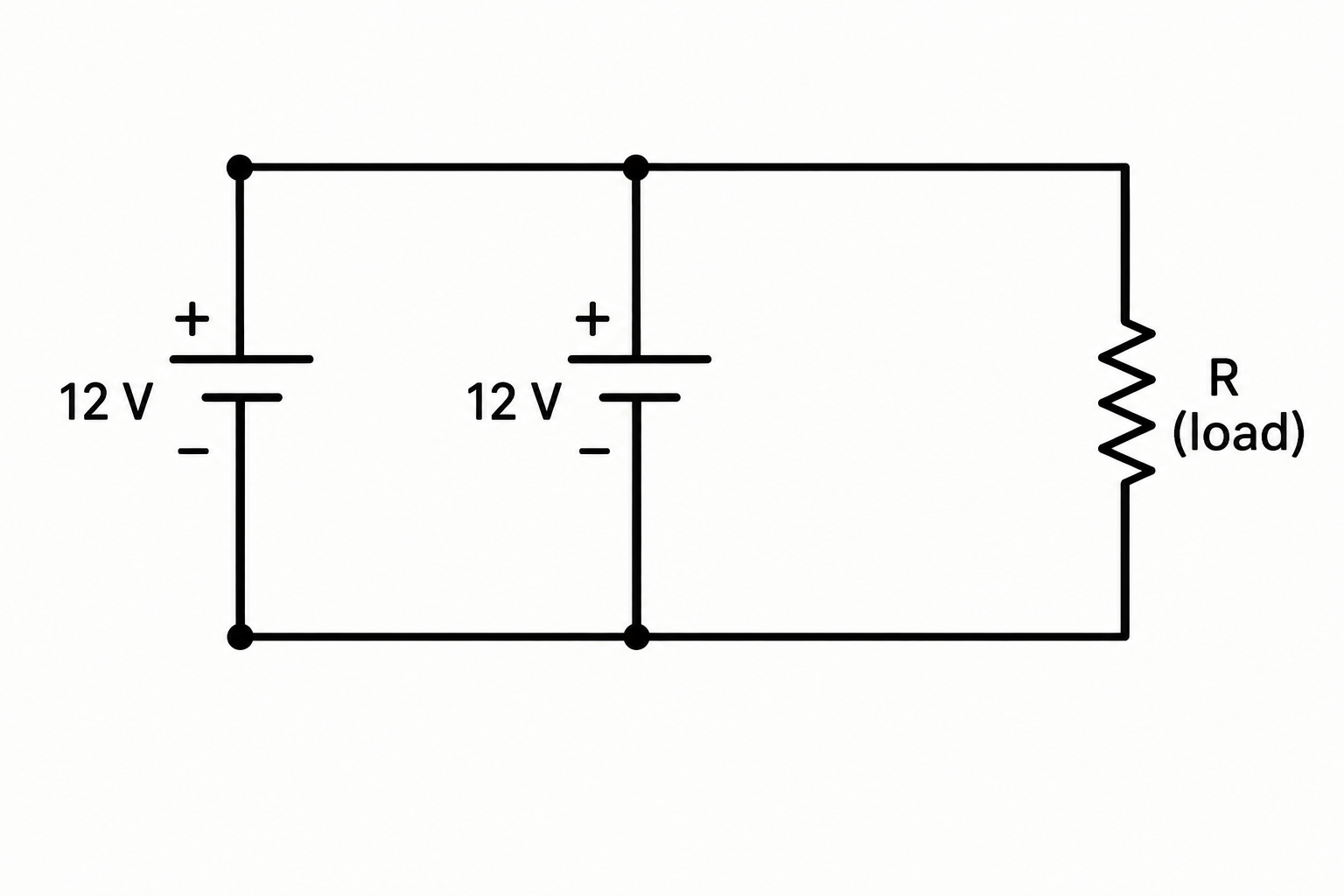
It's not a good idea to put batteries in “parallel” because slight manufacturing differences in their makeup mean they won't contribute equally to moving electrons. And when one is depleted, it will drain the other.
The following is not a good idea!
Most electronic circuits require between 1.2 and 24 volts to operate properly.
ELECTRIC CURRENT FLOW (Amperes)
The flow of electrical charge (electrons) through a wire or electrical component is measured in Amperes. I.E. the Ampere is the unit of electrical current. If 6.25 x 10E18 electrons move through a electrical wire or electronics device per second, that's 1 Amp (or 1A) of current flow! [Note: 10E18 is 1,000,000,000,000,000,000 or 1 with 18 zeros following it.]
ELECTRIC POWER (Watts)
The unit of energy is the Joule (which is what it takes to heat one cubic centimeter of water by one degree Centigrade). There are other units of energy such as the KWH (kilowatt hour) and BTU (British Therm. Unit).
Power is the rate of flow of energy into or out of something. The unit of power is a Watt, and is a flow of energy from some place to another, of one joule per second.
You calculate power going into a device using the EMF impressed across it and the current flowing though it:
P = V * I
[number of watts is number of volts times number of amperes]
QUESTION:
If 0.5 Ampere of current is flowing out of a 12 volt battery, how much power is flowing out of it?