ELECTRONIC
CIRCUITS
LESSON 3 - USING a RESISTOR to LIGHT UP an LED
RESISTANCE:
Resistance to current flow has to be part of any electrical equipment. Else, any EMF would cause infinite current to flow.
RESISTORS:
Resistors are devices that resist current flow in a very nice way! The symbol (used in schematics) for a resistor
is: 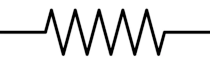 . How much resistance it
offers to current flow is measured in Ohms.
. How much resistance it
offers to current flow is measured in Ohms.
Resistors can vary in (resistance) value from about .01 Ohms to 10's of millions of Ohms. You can measure resistance of a resistor by placing a voltage across it and determining the current flowing through it.
How much current flows through a resistor is determined by the formula:
I = V/R
For example, if you place an EMF of 5V across a 100 Ohm resistor, a current of 0.05A will flow!
ONE GOOD USE FOR RESISTORS:
A 'Light Emitting Diode' is useful for indicating the status of some aspect of a circuit to the human user of
the circuit. A typical LED needs to have 0.01 Ampere of current go through it to light-up, and at that current
about 1.3 volts will be the voltage across it. If a significantly less voltage is impressed upon it, it simply
will not light-up. If a significantly higher voltage is impressed upon it (say the batteries full 5 volts), a
large and potentially damaging current will flow into it (0.5A or more). That is, you can't simply attach a
battery to it!
We want the following circuit to 'make' 0.01A flow through it, and presume the battery voltage is 5 volts:
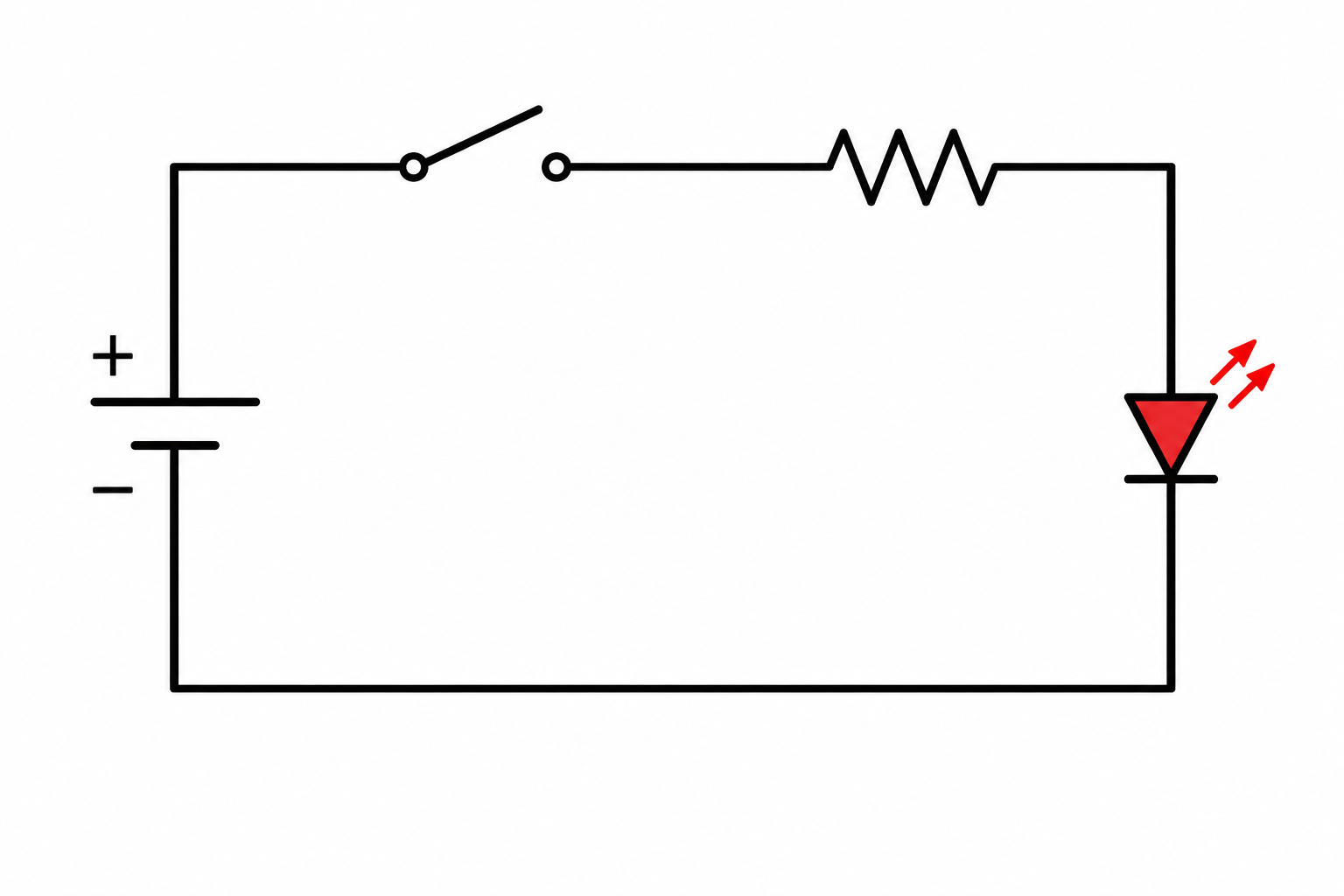
We know the voltage we need across the resistor (3.7 volts = 5.0 volts – 1.3 volts), and we know the current flow
through the resistor (0.01 A), so we can solve the formula above to determine the resistance:
I = V/R or 0.01A = 3.7V / R
or
R = V/I or R = 3.7V / 0.01A which is 370 Ohms.
QUESTIONS:
1. How much power is dissipated in the LED (hint: 1.3 volts times 0.01 amps)?
2. How much power is dissipated in the resistor?
3. If we didn't use the resistor, how else could we have kept the LED current at 0.01A?